

A small maker launches a new line of prints, candles, rosaries, notebooks, ceramics, or devotional objects. The work has merit. The materials are decent. The photographs are clear enough. Yet the whole presentation circles the founder like moths around a porch lamp.
The About page begins with childhood wounds. The product description mentions the maker’s journey three times before naming the object once. The package includes a long note about courage, creativity, burnout, healing, and the importance of chasing dreams. The buyer ordered a framed print of Saint Michael and received a memoir with cardboard corners.
This is founder vanity wearing humble shoes.
The modern market encourages the maker to become the product. Tell your story. Show your face. Share your process. Build a personal brand. Some of this has honest use. A buyer should know that a human being made the thing. Yet sacred objects, heirloom goods, and symbolically serious work suffer when the founder’s personality fills the room.
The buyer came looking for an object that could carry memory, devotion, beauty, or household order. Instead, the buyer meets the maker’s self-explanation standing in the doorway, waving both arms.
The Ancient Pattern
The Byzantine icon painter offers the useful pattern.
The icon, within Orthodox and Eastern Christian tradition, is not treated as a private act of self-expression. Its forms are inherited. Its figures follow recognizable patterns. The painter works within discipline, prayer, fasting in some settings, technical training, and submission to established models. The iconographer may be known, skilled, and respected, but the icon does not exist to display his originality.
This gives the icon a strange force. It looks received before it looks invented.
The painter’s hand is present, yet restrained. Personal flair does not vanish entirely. Line, color, proportion, tenderness, severity, and finish still reveal craft. Yet the work points beyond the maker. The holy figure, the feast, the biblical event, the theological meaning, and the prayerful setting carry the weight.
The iconographer hides himself so the visible image can serve an invisible reality. That hiding is not weakness. It is discipline. A trumpet sounds better when the player stops explaining the brass.
Modern makers cannot simply borrow the icon’s sacred authority. An icon belongs to a religious tradition with doctrine, blessing, liturgical use, and communal memory. Yet the marketing lesson is sharp: when the work carries a serious promise, the maker’s ego must learn to kneel.
The Governing Judgment
A brand gains gravity when it knows what should stand in front.
For a maker of sacred art, heirloom goods, or symbolically serious products, the founder should support the object, not crowd it. The buyer wants to know who made the work, where it came from, what it is made of, how it should be kept, and what kind of life it belongs to. The buyer does not need a founder’s emotional weather report attached to every listing.
Sacredness differs from decoration. A product becomes decorative when symbols are used as attractive surfaces. A product gains sacred force when form, purpose, setting, and use agree. A wall cross wrapped in bubble mailer with neon thank-you stickers sends one message. A wall cross wrapped plainly, named clearly, and accompanied by a small card explaining placement in the home sends another.
Intimacy differs from smallness. A small object can feel grave when it is named, handled, photographed, and packaged with care. A large object can feel cheap when it begs for attention.
Mystery differs from confusion. The maker should not bury the buyer under vague phrases about energy, ancient wisdom, and hidden codes. Mystery comes from restraint, use, and reverent distance. Confusion comes from a fog machine rented by the ego.
The icon painter’s lesson may be adapted honestly through restraint, repetition, inherited pattern, sober naming, disciplined photography, modest founder presence, and clear ritual use. The theological status of the icon belongs to the Church. A modern brand may borrow the posture of humility. It may not borrow holiness as a costume.
The Machinery of Value
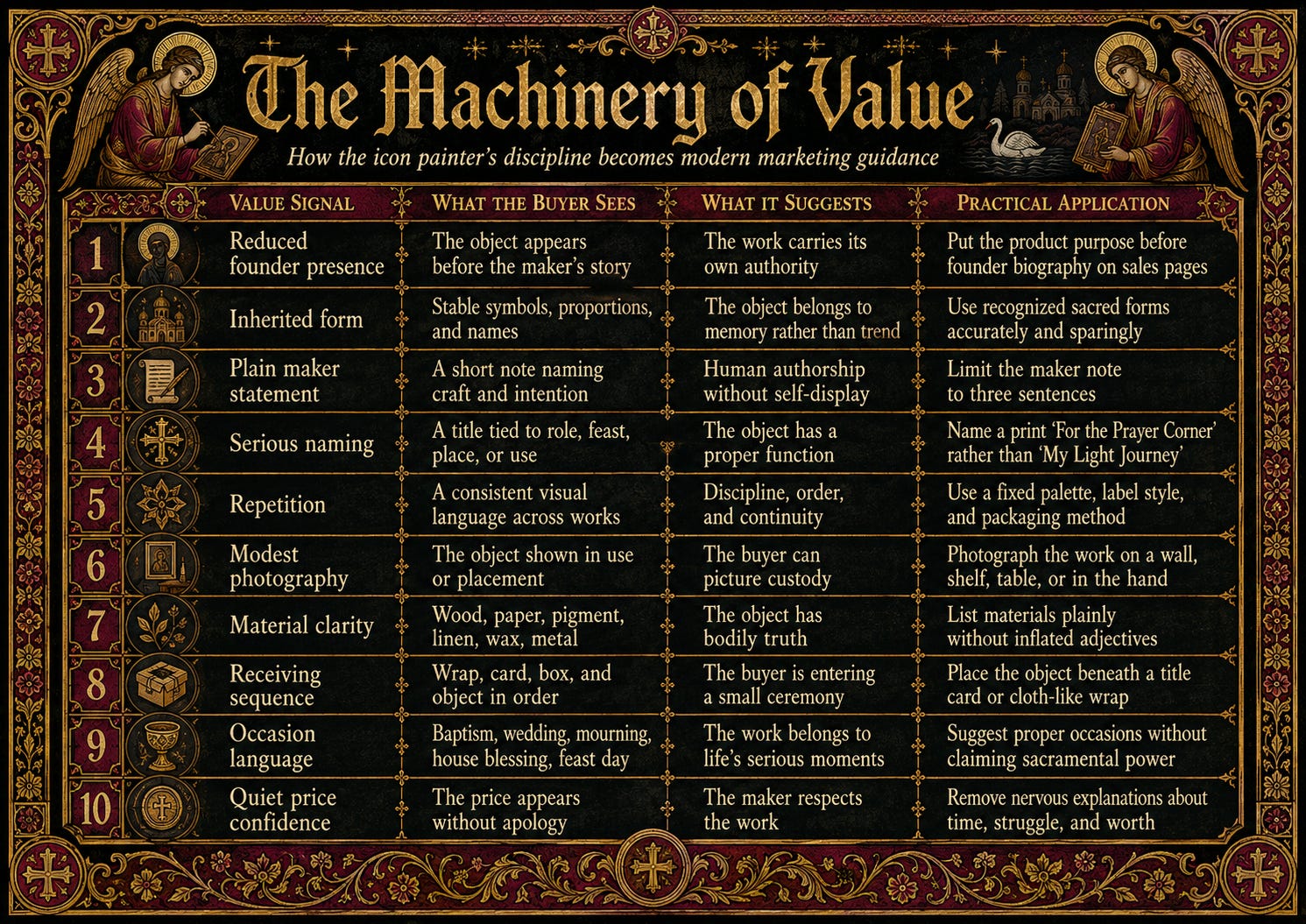
The Workshop Protocol
Open one product page and move the object description above the founder story.
Reduce the founder biography on that page to three sentences: who made it, where it was made, and what discipline shaped it.
Replace any title based on personal emotion with a title based on use, place, or occasion.
Remove one photograph that centers the maker and replace it with a photograph of the object in its proper setting.
Write a one-sentence purpose line for the object, such as “Made for a prayer corner, memorial shelf, or family wall.”
Create a small card that includes title, date, materials, size, maker name, and intended setting.
Use the same wrap, card placement, and box order for every object in the series.
Cut any phrase that claims vague ancient power without naming a real source.
Keep one founder photograph on the About page, not on every product page.
Ask whether the buyer remembers the object after reading the page, or mainly remembers the maker talking about the object. Revise until the object stands first.
The Counterfeit Shrine
This method can rot.
A maker may confuse humility with theater. He may write, “I am merely a vessel,” beneath twelve portrait photographs and a seven-part origin story. The halo of modesty becomes another selfie filter. The little machine squeaks, but it still runs.
Another corruption is false authority. A brand may adopt icon language, sacred postures, gold backgrounds, Greek lettering, and liturgical phrases while knowing little about the religious tradition involved. This produces costume-shop sanctity. The result may amaze at first glance, then collapse under inspection.
A third corruption is hiding responsibility. The maker should not vanish when the buyer needs clarity. Materials, pricing, edition size, shipping, returns, and authorship should be plain. Holy restraint does not excuse poor communication. Silence can dignify an object. Silence can also conceal a mess.
The boundary is simple. Raising perceived value means arranging the work so its real purpose, material care, and symbolic weight can be seen. Deceiving the buyer means using sacred manners to inflate an object beyond its truth.
The icon painter teaches a hard mercy: the maker’s self can become too large for the work. When that happens, the object shrinks. The buyer feels the imbalance even when he cannot name it.
A serious object needs room to breathe. It needs a name that does not chatter, a package that does not wink, a photograph that does not flatter, and a maker who can stand behind the work without climbing onto its shoulders.
Memory favors objects that know how to be quiet. Devotion gathers around forms that do not plead. Inheritance rarely attaches itself to noise. The maker who learns to hide himself gives the work a longer life, and gives the buyer a cleaner place to place love, grief, gratitude, and wonder.
A grand world awaits.


