

A maker spends twelve hours carving a small devotional pendant, polishing its edges, testing the cord, and discarding three imperfect versions. Then the finished piece is dropped into a plastic bag with a printed receipt.
The parcel arrives looking like a replacement part for a kitchen appliance.
This failure is common among ceramicists, jewelers, printmakers, iconographers, bookbinders, and other small producers. The object receives concentrated attention. Its arrival receives almost none. Packaging is treated as waste surrounding the real work.
Yet the buyer does not encounter the object by itself. He encounters a sequence.
First comes the parcel. Then the wrapping. Then the first glimpse of the material. Then touch. Then, perhaps, the discovery of a name, date, number, dedication, or maker’s mark.
That sequence governs the object’s entrance into memory.
Cheap packaging does more than lower perceived price. It strips the object of ceremony before the buyer has even held it. The work may be excellent, but its introduction arrives wearing grocery-store shoes.
The Ancient Pattern
Portable objects from the Paleolithic world were often small enough to be carried, worn, handled, or kept close to the body. Surviving examples include carved figures, beads, perforated animal teeth, engraved plaques, and pendants made from bone, antler, stone, or ivory.
A British Museum bone pendant, for example, was deliberately cut and shaped after the softer interior bone had been removed. Its perforated end was narrowed and rounded, showing that suspension formed part of the object’s design rather than being added as an afterthought. Other surviving pendants bear engraved lines, worked surfaces, thinning, polishing, or signs of ancient breakage.
Their precise meanings are often uncertain. Archaeologists cannot recover every story, gesture, or association that once surrounded them. A perforation tells us that an object could be suspended. It does not tell us every occasion on which it was worn.
Still, the physical evidence reveals a governing principle. These objects were made for passage.
They moved from hand to hand, body to body, camp to camp, and perhaps generation to generation. Their smallness encouraged closeness. Their materials came from animals, hunts, places, and labor that already carried consequence. Portable Paleolithic art required a serious expenditure of time, even when the finished object could fit within the palm.
The object’s meaning was therefore inseparable from handling, carrying, wearing, and keeping. It did not begin life as a detached image floating in a white digital square.
Memory had acquired a body.
The Governing Judgment
A modern maker can borrow the principle of meaningful passage without pretending to recreate an Ice Age rite.
The useful lesson concerns arrival. An object gains gravity when its movement from maker to owner is treated as part of the work. Packaging should prepare the hand, govern the pace of discovery, and preserve a small record of origin.
This does not require expensive boxes, artificial antiquing, or theatrical layers of twine. A parcel that takes ten minutes and a pocketknife to open inspires thoughts about burglary, not reverence.
The goal is deliberate sequence.
The buyer should first encounter restraint. Then material. Then information. The object itself should appear last, or nearly last, as the center of the arrangement.
Sacredness cannot be manufactured by wrapping paper. A religious object receives its proper meaning from belief, use, blessing where applicable, and its place within a living tradition. Packaging can acknowledge that meaning. It cannot confer sacramental status.
Likewise, intimacy differs from smallness. A tiny object thrown loose into a padded envelope feels trivial. The same object, wrapped in plain paper and accompanied by a handwritten edition card, feels personally entrusted.
Mystery also differs from confusion. The buyer should understand what the object is, who made it, what materials were used, and how it should be cared for. Concealment should slow discovery for a few seconds. It should never hide basic facts.
The Machinery of Value
Packaging raises perceived value when it makes real qualities easier to see. It fails when it attempts to compensate for weak work through ribbons, seals, and verbal incense.
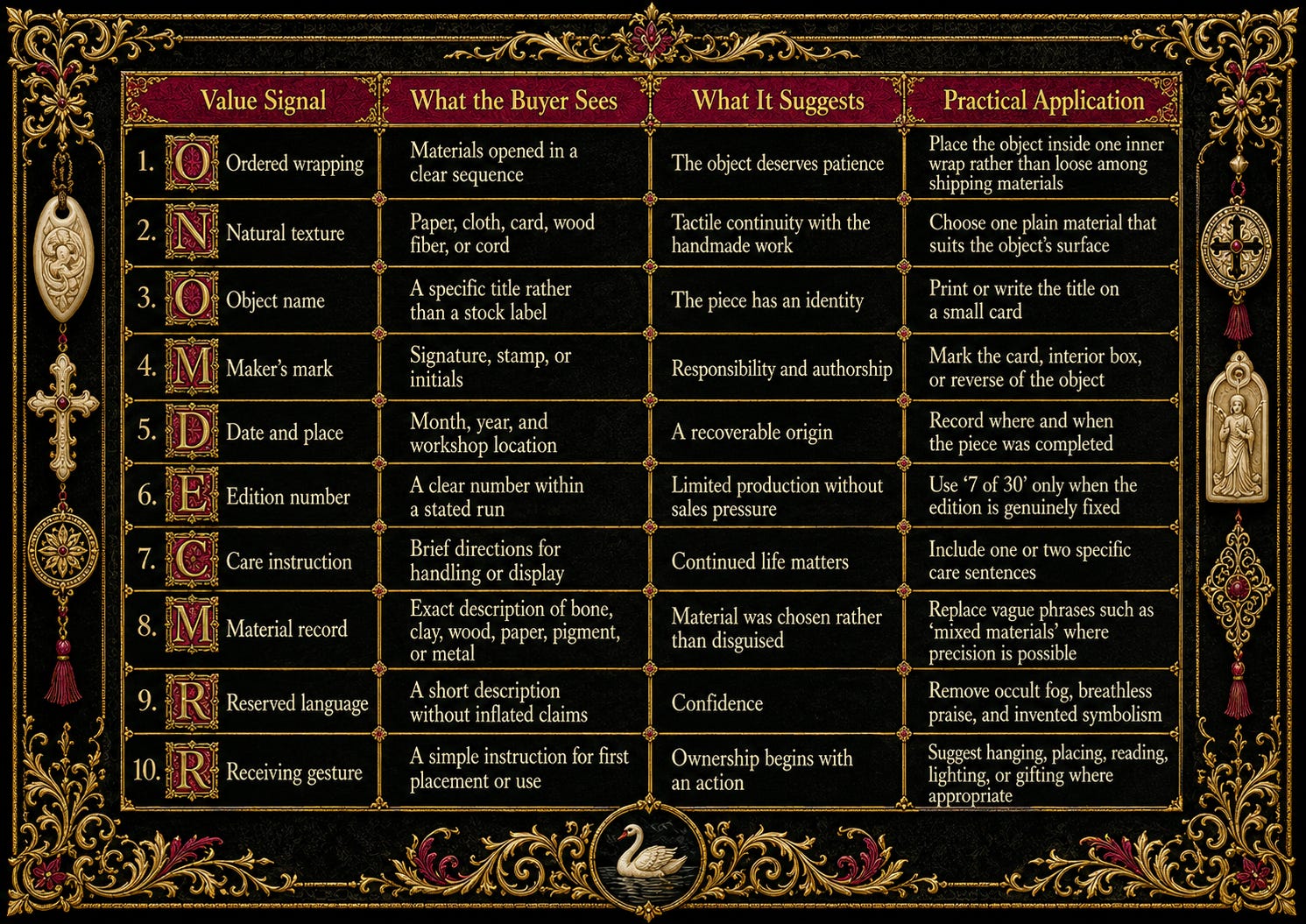
A modest object can arrive with dignity. Dignity has never required a magnetic box the size of a parish register.
The Workshop Protocol
Place the finished object on a clean table beside every material currently used to ship it.
Remove anything printed with unrelated logos, loud patterns, or warehouse markings from the inner presentation.
Choose one inner wrapping material that feels appropriate against the object. Use plain paper, unbleached tissue, a small cloth sleeve, or a fitted card backing.
Arrange the package so the shipping label and protective padding are encountered before the presentation layer.
Give the object a specific title. Write it exactly the same way on the product page, receipt, and enclosed card.
Create a card containing the title, material, completion date, workshop location, and maker’s name.
Add an edition number only when the total quantity has been decided in advance and will remain fixed.
Write one sentence explaining care. “Keep dry and polish with a soft cloth” carries more weight than three paragraphs about eternal craftsmanship.
Wrap the object so it can be opened without tearing the card, cutting the cord, or scattering filler across the room.
Photograph the complete arrival sequence: closed parcel, opened parcel, inner wrap, documentation, and revealed object.
Ask another person to open the package while you watch silently. Record every point at which they hesitate, overlook information, or reach for scissors.
Revise the package until the order of discovery feels clear and calm.
Keep one complete packaged example in the workshop archive. It will become a record of how the object entered the world.
The Counterfeit Shrine
The method becomes corrupt when presentation starts inventing a history the object never possessed.
Do not stain paper with tea to imply age. Do not use ecclesiastical seals without authority. Do not claim that symbols are ancient, sacred, protective, or traditional unless that claim can be defended. A crescent, spiral, animal, eye, cross, or star does not acquire a universal meaning because a product description says so.
Fabricated provenance is especially corrosive. A new object may be inspired by an old material or form. It may not borrow an imaginary lineage.
Manipulative scarcity belongs to the same family of deceit. A maker who announces a final edition, sells it, and produces another final edition has turned numbering into costume jewelry. Scarcity should arise from actual limits: available material, working time, a fixed series, or a decision the maker intends to honor.
Inflated packaging can also become comic. Five nested boxes, black wax, artificial Latin, and a certificate titled “Custodian’s Covenant” may make a wooden pendant feel like it has been detained by a minor secret society.
Raise perceived value by revealing labor, material, authorship, order, and care. Deception begins when presentation supplies qualities the object does not possess.
The oldest portable objects survived because matter was given shape, handled repeatedly, and carried beyond the moment of making. Their first owners are gone. Their names are gone. The objects remain, marked by touch and time.
A modern parcel will rarely survive ten thousand years. It can still declare that the thing inside was made by someone, somewhere, for a human hand. It can give the buyer a date to remember, a name to repeat, and a record to pass onward.
Ordinary matter gains a longer life when its arrival is treated as the beginning of custody rather than the end of a transaction.
A grand world awaits.


