

The cave constitutes the earliest known form of sacred architecture because it gave religious experience a spatial body before human beings possessed formal buildings. Its importance lies in the ordered passage from ordinary daylight into concealed depth. The entrance, passage, chamber, image, flame, and return created a pattern that later temples would refine in stone, wood, bronze, glass, and gold.
The cave begins with a threshold. Outside, the world remains open, visible, and practical. Inside, the air cools, sound tightens, sight narrows, and the body becomes aware of its limits. This change in condition gives the cave its first sacred quality. It separates one kind of space from another. The visitor does not merely walk into shelter. He crosses from common life into an interior world.
That threshold is the first architectural fact of religion. Later sacred buildings would repeat it through gates, porches, courts, screens, narthexes, doors, curtains, and sanctuaries. The cave gives the original pattern without masonry. It marks the passage from daily use into charged presence. The human body understands this before doctrine explains it.
The descent into the cave gives movement a ritual character. A person entering a painted chamber must slow down, bend, crouch, steady himself, and carry light. The route may require awkward labor. This effort matters. Sacred space often resists casual entry because reverence grows through approach. The cave teaches by making the body participate.
This feature appears throughout later religious architecture. A temple does more than house a holy object. It arranges approach. The visitor passes through ordered space before reaching the center. The procession, the pilgrimage road, the sanctuary steps, and the veiled altar all preserve the cave’s older lesson. A sacred center gains authority through distance, restriction, and preparation.
The cave also establishes the importance of hiddenness. Its painted animals often appear deep within the earth, far from ordinary convenience. The location changes the meaning of the image. A bison painted near an entrance would speak differently from a bison found after descent, darkness, silence, and flame. The place magnifies the figure.
This insight is central to the study of prehistoric art. The image and the cave cannot be separated without damage to both. The wall is not a neutral background. It is a surface already shaped by natural forms. Bulges, cracks, hollows, ridges, and slopes participate in the animal’s body. The artist reads the stone, then answers it. The result is neither decoration nor detached illustration. It is an encounter between natural form and human mark.
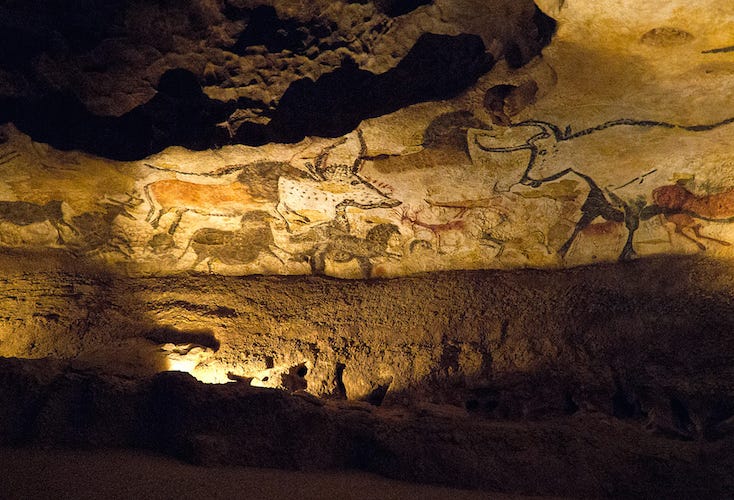
This is why recent reflections on Chauvet Cave and the ancient iconographic impulse are useful for understanding cave art as more than primitive image-making. The animal does not sit politely on the wall like a framed print in a dentist’s office. It emerges from stone. It appears through the tension between pigment, surface, shadow, and memory. The cave does not contain the art as a storage room contains chairs. It performs the art.
Fire intensifies this performance. Under a moving flame, the animal seems to stir. A horn emerges from darkness, a line brightens, a flank disappears, and the wall changes with each breath. Electric light makes the image stable. Flame makes it alive. The viewer receives the image in fragments. The cave trains sight as a form of patience.
This gives the cave a liturgical quality. Vision is not seized all at once. It is granted in portions. The visitor must move, wait, and receive. Modern image consumption trains the opposite habit. A person swipes through images at a speed that would make an old monk drop his candle into the soup. The cave allows no such laziness. To see one animal in the deep dark, the body must go there.
The use of ochre strengthens the religious character of the cave. Ochre appears across ancient burial, body-marking, and wall-painting contexts. Its color evokes blood, earth, life, death, and return. The ritual importance of pigment has been discussed in Substack reflections on the ritualistic uses of ochre, where pigment appears as a material of contact rather than mere color. In the cave, ochre does not simply make an image visible. It joins body, earth, animal, and memory.
The hand stencil offers one of the clearest examples. A hand pressed to stone, with pigment blown around it, leaves a human absence shaped by contact. It is not a portrait in the modern sense. It is a trace. It records that someone entered the earth, touched the wall, and left a sign of presence behind. Later sacred buildings preserve similar traces through worn thresholds, polished rails, darkened icons, scratched pilgrim marks, and stones rubbed smooth by petitions. The cave stands at the beginning of that confidence: matter can remember.
The cave also functions as an early sacred center. Mircea Eliade’s theory of sacred space helps explain this pattern. A sacred place interrupts ordinary space by creating orientation, center, and contact with a higher or deeper order. Substack essays on the axis mundi and sacred space describe this principle through the vertical connection of heaven, earth, and underworld. The cave offers a subterranean version of that center. Its holiness is found through descent.
This descent should not be reduced to one tidy explanation. The cave may have suggested womb, grave, animal belly, underworld, spirit chamber, or the hidden body of the earth. The evidence invites reverent caution. Recent work on prehistoric rock art and ritual experience points toward music, firelight, movement, and ceremony as part of a fuller setting. The paintings likely belonged to a total experience, not a quiet gallery visit with better mammoths.
The animal images carry the weight of dependence. The creatures painted in the depths were not scenery. They were food, danger, strength, grace, fear, and gift. A bison could mean survival and death. A horse could mean speed and majesty. A lion could mean terror moving with perfect calm. The animal world stood above man in power even when man hunted within it. The cave gathered that dependence into visible form.
This is where sacred art begins: the visible presentation of powers that exceed human control. The cave animal remains animal, sign, memory, dread, and gift. It refuses to become one thin thing. Good sacred art has this density. Bad commentary often tries to flatten it afterward, wearing sensible shoes and carrying a clipboard.
The cave’s architectural logic continues through later sacred buildings. The threshold becomes the gate. The passage becomes procession. The chamber becomes sanctuary. The wall image becomes icon, fresco, relief, mosaic, and stained glass. The flame becomes candle, lamp, censer, and glimmer before a holy face. The cave’s descent finds later counterparts in temple ascent, mountain pilgrimage, crypt, shrine, and altar.
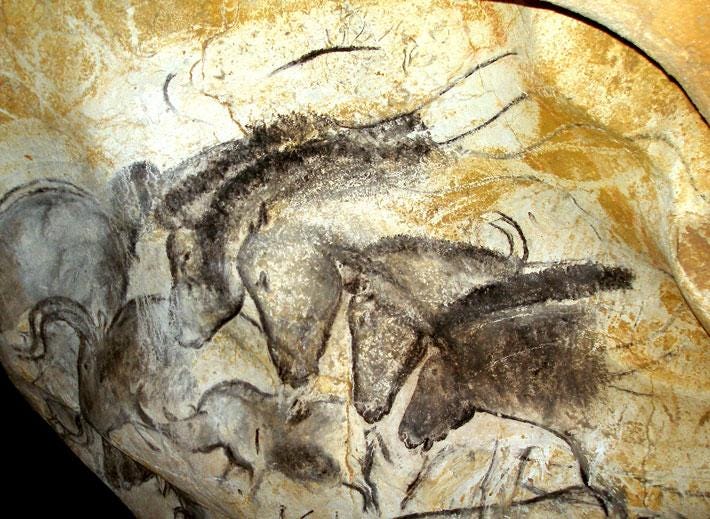
A cathedral uses height to draw the soul upward. A cave uses depth to draw the body inward. Both take the human being out of ordinary space and place him under a larger order. Both change posture, attention, sound, movement, and time. Both show that sacred architecture forms belief through the senses.
The cave also changes time. Outside, time is weather, daylight, hunger, movement, and animal track. Inside, time thickens. Stone preserves marks across generations. A handprint, a line of charcoal, or a trace of flame holds the gesture of a vanished person. The cave becomes memory made architectural.
For this reason, the cave should be treated as a complete sacred form rather than an unfinished cathedral. It possesses its own majesty: darkness, danger, secrecy, image, flame, and return. Its greatness lies in severity. It does not flatter the visitor. It chills him, narrows his sight, teaches his body humility, and gives him the animal in the dark.
The cave gave mankind the first grammar of sacred space. It taught that a path can become reverence, a chamber can become presence, a wall can become veil, a mark can become memory, and a flame can become revelation. Later civilizations would build upward with royal wealth and priestly order. The first lesson had already been given beneath the earth.
At the edge of daylight, man entered stone with fire. In the darkness, he found the world deeper than it looked.


